Choosing the right Hacksaw Tools for global sourcing requires more than comparing prices. Buyers must examine cutting performance, materials, safety, supplier reliability, and long-term operating costs. A polished product photo proves very little.
A dependable hacksaw should feel balanced in the hand, hold its blade securely, and resist frame distortion under pressure. Check whether the frame uses hardened steel, coated alloy, or another documented material. Confirm blade length, teeth per inch, tension adjustment, handle design, and replacement-blade compatibility. These details affect both workshop efficiency and user safety.
Real sourcing decisions begin with evidence. Request product samples before placing a large order. Test them on the materials your customers actually cut, such as mild steel, aluminum, or plastic pipe. Inspect the blade after repeated strokes. Does it stay straight? Does the handle loosen? Does the coating scratch during normal use? Ask suppliers for material specifications, inspection records, packaging details, and clear quality-control procedures. Independent testing can add confidence when claims remain unclear.
Small details matter.
Packaging also deserves attention. Weak cartons may leave frames bent after ocean transport, even when the factory’s sample looked excellent. Compare several suppliers, review their production experience, and verify communication during the sampling stage. Certifications can support trust, but they should be checked against the actual product and destination requirements.
There is no universal “best” option. An inexpensive tool may fail quickly, while a premium model may exceed the customer’s needs. Even experienced buyers get this wrong. The strongest choice balances performance, compliance, service, and total landed cost. A careful evaluation process makes that balance visible before money and reputation are committed.
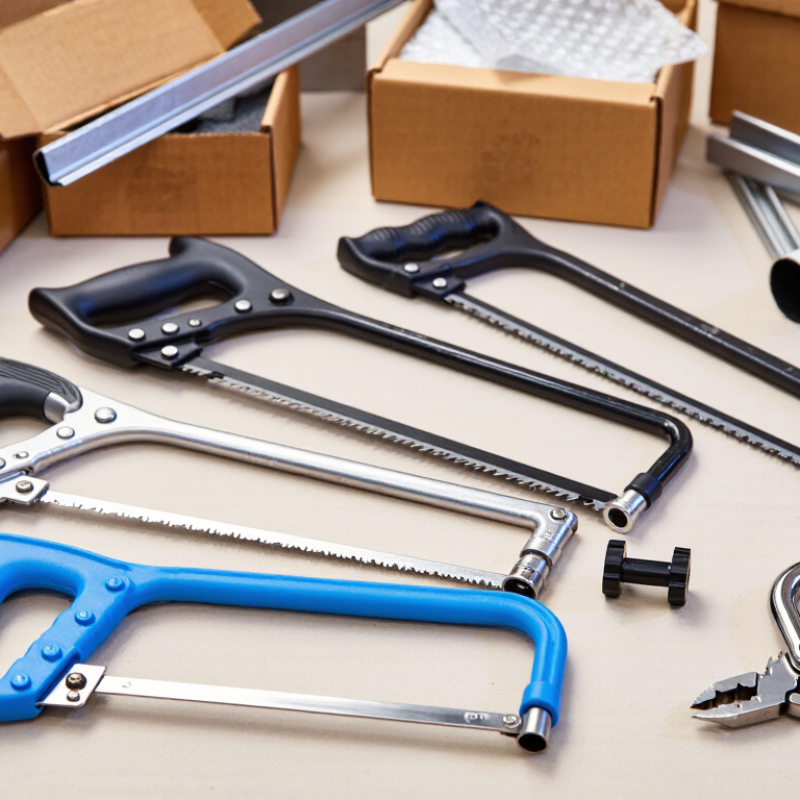
Choosing the right hacksaw begins with matching the tool type to the cutting environment. A standard hand hacksaw suits general workshop maintenance and straight cuts. A junior hacksaw works better in narrow spaces and on lighter stock. Adjustable-frame models provide greater flexibility for different blade lengths, but their tension mechanism deserves careful inspection. A loose blade wanders. That creates waste.
Blade material affects service life and cutting control. Carbon steel blades are economical for soft metals, plastic, and occasional repairs. Bi-metal blades combine a flexible alloy body with a harder high-speed steel edge. They usually resist tooth breakage during repeated production work. Hardened high-speed steel blades can cut tougher alloys, but they may be less forgiving when alignment is poor. Check the blade’s hardness, weld quality, width, and thickness before placing a large order.
Tooth pitch is equally important. Choose 14 TPI for thick steel sections and fast material removal. Use 18 TPI for medium wall tubing and general fabrication. An **24 TPI blade handles thinner steel, copper pipe, and sheet material more cleanly. Choose 32 TPI for thin sheet, small tubing, and delicate cuts. At least three teeth should contact the workpiece during cutting. Otherwise, teeth can snag or strip.
For global sourcing, request samples with identical dimensions and test them under controlled pressure. Compare cutting speed, tooth loss, blade straightness, and packaging protection. Supplier claims are useful, but physical results matter more. I would not rely on TPI alone. Some specifications look precise, yet inconsistent tooth setting can ruin performance. Recheck samples after storage and transport. Temperature and moisture may expose weaknesses later.
Hacksaw selection depends on frame type, blade material, workpiece thickness, and tooth density. The chart compares common blade options from 14 to 32 teeth per inch (TPI). Tooth pitch is calculated as 25.4 ÷ TPI.
Fixed frames are simple and economical. Adjustable frames accept different blade lengths. High-tension frames improve cutting control and reduce blade deflection.
Carbon steel is suited to general-purpose cutting. High-speed steel improves wear resistance. Bi-metal blades combine a flexible alloy-steel body with a harder high-speed-steel cutting edge.
Lower TPI removes material faster on thick sections. Higher TPI produces a finer cut on thin-wall tubing, sheet metal, and small solid sections.
Practical rule: keep at least 2–3 teeth engaged in the workpiece during cutting. Actual performance also depends on blade thickness, tooth geometry, cutting speed, and workpiece material.
In global sourcing, the right hacksaw starts with the material, not the handle. I check hardness, thickness, and cutting volume before comparing suppliers. Mild steel, aluminum, copper, and hardened alloy each demand a different blade choice. A blade that works on thin aluminum may chatter on thick steel. That sound is useful evidence.
For thin sheet and small tubing, use a fine blade with higher TPI, often 24 to 32. More teeth keep the cut controlled and reduce snagging. Thick steel usually needs fewer teeth, such as 14 to 18 TPI, so each tooth can clear more material.
For general workshop work, 18 to 24 TPI offers a practical compromise. Do not force the frame. Let the teeth work.
I also ask suppliers for blade tension range, frame rigidity, replacement-blade availability, and sample-cut records. These details reveal more than polished catalog photographs. A rigid frame helps maintain a straighter cut during long strokes.
Still, TPI alone cannot predict performance. Tooth geometry, blade material, operator pressure, and lubrication matter too. I once selected a fine blade for a thick stainless section and created heat, not progress. That mistake changed my inspection checklist.
When sourcing internationally, request material samples and verify claims against measured cuts. Keep tolerances, packaging, and spare-blade supply in the same purchase discussion. Small omissions become expensive delays.
When choosing hacksaw blades for global sourcing, compare measurable properties rather than attractive packaging. ASM Handbook data places many high-speed steels near 62–67 HRC after heat treatment. Carbon tool steels commonly sit lower, around 58–62 HRC. Hardness helps retain sharp teeth, but it does not guarantee longer cutting life. Tooth geometry, blade tension, and operator pressure can change results sharply.
Bi-metal blades combine HSS teeth with a flexible spring-steel back. This structure usually tolerates vibration and interrupted cuts better than solid HSS. Solid HSS can cut hard stainless alloys efficiently, but its higher brittleness increases breakage risk. Carbon steel costs less and suits mild steel, plastic, and occasional maintenance work. ASTM A600-23 defines important HSS requirements, while ISO 6508-1:2016 supports comparable Rockwell hardness testing. These standards improve sourcing confidence, but they do not replace practical trials.
Test three samples on the same saw, material, pitch, speed, and coolant. Record cutting time, tooth loss, breakage, and cost per cut. Small details matter. A lower-priced carbon blade may win on clean mild steel. A bi-metal blade may reduce replacement delays across mixed workshops. My own caution: hardness figures are easy to overvalue. A blade with excellent laboratory hardness can still underperform when tension is uneven or chips clog its gullets. Always request traceable test data, batch information, and independent inspection records before placing a large order.
How to Choose the Best Hacksaw Tools for Global Sourcing
ISO 2336:2006 gives buyers a reliable dimensional reference for hand hacksaws and blades. Confirm the required 300 mm blade length against the standard drawing, not only a supplier’s product title. Check blade width, thickness, pitch, hole position, and mounting features. A nominal 300 mm length can hide small dimensional differences. Those differences may prevent clean installation. The 2024 Global Hand Tools Market analysis by Grand View Research estimated the sector at approximately USD 24 billion in 2023. That scale increases sourcing options, but also increases specification risk. Use calibrated steel rules, digital calipers, and incoming inspection records. Keep photographs with each measurement.
Handle compatibility deserves equal attention. Verify the distance between mounting pins, slot shape, clamp clearance, and tensioning travel. A handle may accept a 300 mm blade but still leave poor alignment or unsafe tension. In factory audits, I have seen buyers approve samples without checking the handle under working load. That was an avoidable mistake. Request a dimensional inspection report based on ISO 2336, plus a compatibility sample before mass production. Review the report against the actual batch. A 2023 quality-management survey published by the International Organization for Standardization reported millions of certified management-system sites globally, yet certification alone does not prove product fit. It shows process control, not dimensional perfection. Small gaps remain.
| Evaluation Dimension | Recommended Specification or Reference | Why It Matters for Sourcing | Verification Method | Procurement Note |
|---|---|---|---|---|
| Applicable standard | ISO 2336:2006, Hand hacksaw blades — Dimensions | Provides a recognized dimensional reference for hand hacksaw blades and supports consistent international specifications. | Request the applicable edition, dimensional drawing, and a measurement report from the supplier. Confirm that the claim refers to dimensions, not automatic product certification. | List ISO 2336 as a dimensional reference in the purchase specification. |
| Nominal blade length | 300 mm, measured as the nominal distance between the blade mounting points. | 300 mm blades are widely used with full-size hand hacksaw frames and provide a practical balance between cutting capacity and availability. | Measure a sample using a calibrated steel rule or caliper and compare it with the technical drawing. | Define the required tolerance separately; do not treat “300 mm” as an unrestricted tolerance. |
| Blade width | Common full-size designs are approximately 12–13 mm wide; confirm the exact ISO 2336 dimension required for the selected design. | Width affects frame clearance, lateral stability, and compatibility with blade retainers. | Measure at several points away from the teeth and compare with the approved drawing. | Avoid accepting a generic “standard width” description without a numerical value. |
| Blade thickness | Common 300 mm blades are approximately 0.6–0.8 mm thick; the exact value must be specified by the product drawing. | Thickness influences stiffness, kerf width, cutting control, and fit in the frame slots. | Use a micrometer at multiple positions and record the average and maximum deviation. | Specify whether the thickness applies to the backing strip, tooth set, or both. |
| Tooth pitch | Typical choices: 18 TPI for heavier sections, 24 TPI for general-purpose cutting, and 32 TPI for thin-wall materials. | The correct pitch helps maintain at least several teeth in the workpiece and reduces snagging or tooth stripping. | Count teeth over a measured one-inch section or verify the stated TPI on the packaging and inspection report. | Use separate stock-keeping units when multiple TPI options are required. |
| Tooth configuration | Regular or variable-pitch tooth patterns; choose according to the target material and cutting application. | Tooth geometry affects cutting speed, vibration, finish, and resistance to tooth breakage. | Review tooth drawings and conduct a cutting test using the intended material thickness. | Do not compare TPI alone; tooth shape and set are also important. |
| Blade material | High-speed steel, bi-metal construction, or hardened carbon/alloy steel, depending on the cutting duty. | Material selection affects toughness, wear resistance, cutting life, and the risk of fracture. | Request the material designation, heat-treatment details, and a batch test report where applicable. | Require clear terminology such as “bi-metal” plus the stated tooth material and backing material. |
| Mounting-hole and pin interface | Hole diameter, hole shape, hole position, and end geometry must match the selected frame; these values should be taken from the approved drawing. | A correct 300 mm length does not guarantee that the blade will fit every handle or frame. | Compare the blade holes with the frame pins using a physical fit test and dimensional inspection. | Include a compatibility sample with the purchase order. |
| Handle or frame compatibility | Full-size adjustable frames designed for nominal 300 mm blades; confirm both pin spacing and tensioning travel. | Frame capacity and blade interface determine whether the tool can tension the blade safely and maintain a straight cut. | Install the blade in the intended frame, apply normal tension, and check alignment, clearance, and secure retention. | State “300 mm blade compatible” only after a documented fit test. |
| Frame construction | Rigid steel or reinforced composite frame with an adjustable tensioning mechanism. | Frame rigidity supports cutting accuracy and reduces blade deflection under load. | Inspect welds, joints, alignment, tensioning threads, and handle attachment; perform a controlled cutting trial. | Define acceptable deformation and functional requirements in the inspection plan. |
| Handle ergonomics | Secure, non-slip grip with adequate clearance for gloved use and no sharp edges or flash. | Grip comfort and retention affect user control, fatigue, and safe operation. | Conduct a visual inspection, grip assessment, and pull or twist check appropriate to the handle design. | Specify handle material, surface finish, and assembly method without relying on appearance alone. |
| Blade tensioning | Adjustable tension system with smooth operation and reliable retention at normal working tension. | Insufficient or uneven tension can cause wandering cuts, vibration, or blade release. | Check thread engagement, adjustability, locking action, and blade alignment during assembly. | Provide assembly instructions and define the required tensioning function in the specification. |
| Corrosion protection | Suitable protective coating, oil film, or corrosion-resistant material for the intended storage and transport conditions. | Humidity, sea transport, and long storage periods can cause rust on blades, pins, and frames. | Inspect packaging and samples after humidity or accelerated corrosion testing when required by the purchasing program. | Specify individual blade packaging and moisture-control requirements for ocean freight. |
| Quality-control documents | Approved drawing, material declaration, dimensional inspection report, functional test record, and batch traceability. | Documented evidence reduces the risk of dimensional variation and unverified standard claims. | Review documents against the purchase order and verify a sample from the shipped batch. | Make document submission a pre-shipment approval condition. |
| Packaging and labeling | Label each package with blade length, width, thickness, TPI, material, quantity, lot code, and country of origin where required. | Clear identification supports customs processing, warehouse control, replenishment, and product traceability. | Compare carton and inner-pack labels with the approved artwork and purchase order. | Use moisture-resistant packaging for international transport and long-term storage. |
Choosing hacksaw suppliers requires more than comparing unit prices. Start with MOQ, because a low quotation can hide excess inventory. Ask for tiered pricing at 500, 1,000, and 5,000 units. Then match each level with realistic monthly demand. A smaller MOQ may cost more per tool, but it can protect cash flow and reduce warehouse aging.
Lead time should include production, inspection, export handling, and inland delivery. World Bank’s 2023 Logistics Performance Index shows that customs and infrastructure still create major differences between sourcing markets. Request a dated production schedule, not a broad promise. Test reports should identify the exact sample, batch number, testing method, and acceptance limit. For hacksaws, verify frame strength, blade hardness, corrosion resistance, handle grip, and cutting performance. Reports from laboratories operating under ISO/IEC 17025 provide stronger evidence than an unsigned factory sheet.
Calculate total landed cost before approval. Include the product price, tooling, packaging, inspection, freight, insurance, duty, customs fees, and local delivery. UNCTAD’s Review of Maritime Transport reports that ships carry over 80% of global merchandise trade, yet ocean delays can still disrupt arrival plans. Add a practical buffer. I often see buyers ignore rework and port storage. That mistake is expensive. A simple supplier scorecard can assign points for MOQ, lead time, report quality, defect history, and landed cost. The cheapest offer may fail the test. Sometimes, my own forecast is wrong. Recheck demand after the first shipment.